

Heartflow
Positioning a market leader for its next phase of growth.
Background
Heartflow is the market leader in FFRct analysis — the AI technology that turns a single CT scan into a personalized 3D model of a patient's heart. But the company was on the edge of a bigger shift: with the addition of a new plaque-analysis product, Heartflow was no longer just a diagnostic tool. It was becoming a platform for managing coronary artery disease (CAD) over a patient's lifetime. The brand needed to catch up to that ambition.
Challenge
Heartflow's clinical reputation was strong — physicians already trusted the product. But the brand itself was still communicating like a single-point diagnostic tool, not the end-to-end disease-management platform the company was becoming.
The strategic question wasn't "how do we get noticed" — it was "how do we earn the right to lead a category we're actively redefining."
That meant building a brand platform that could do three things at once:
1. Unify a growing portfolio of products under one clear idea
2. Give Heartflow's team the story to sell a bigger vision
3. Hold up under scrutiny from a notoriously skeptical audience — cardiologists, radiologists, and hospital C-suite who don't respond to hype.
Insight
The job wasn’t convincing clinicians to trust AI. The target mindset was already sold on AI as the future of cardiology; skepticism about the technology itself wasn't the barrier.
The real opportunity was elsewhere: roughly 95% of the market was still diagnosing CAD without any advanced technology at all, relying on legacy pathways like stress testing and invasive angiography. Heartflow's real competition wasn't another AI tool or a digital rival — it was inertia, the default assumption that the old way was good enough.
That reframed the strategy. Instead of selling AI, the brand needed to sell a way of thinking: that clarity and confidence shouldn't be optional in a clinical decision, and that the status quo — not a competitor — was what stood between clinicians and better outcomes. The platform was built to position against that mindset, not against any single rival.
Tagline
This contains two parts of our story but means three things. “See CAD” speaks to the ability to see coronary artery disease in never-before-seen detail, fostering a greater understanding of the disease. “Manage for life” communicates that clinicians can manage this disease for the lifetime of their patients. But upon further reflection, it also means managing disease to save, to lengthen, and to improve lives – literally for life itself.
Brand Platform
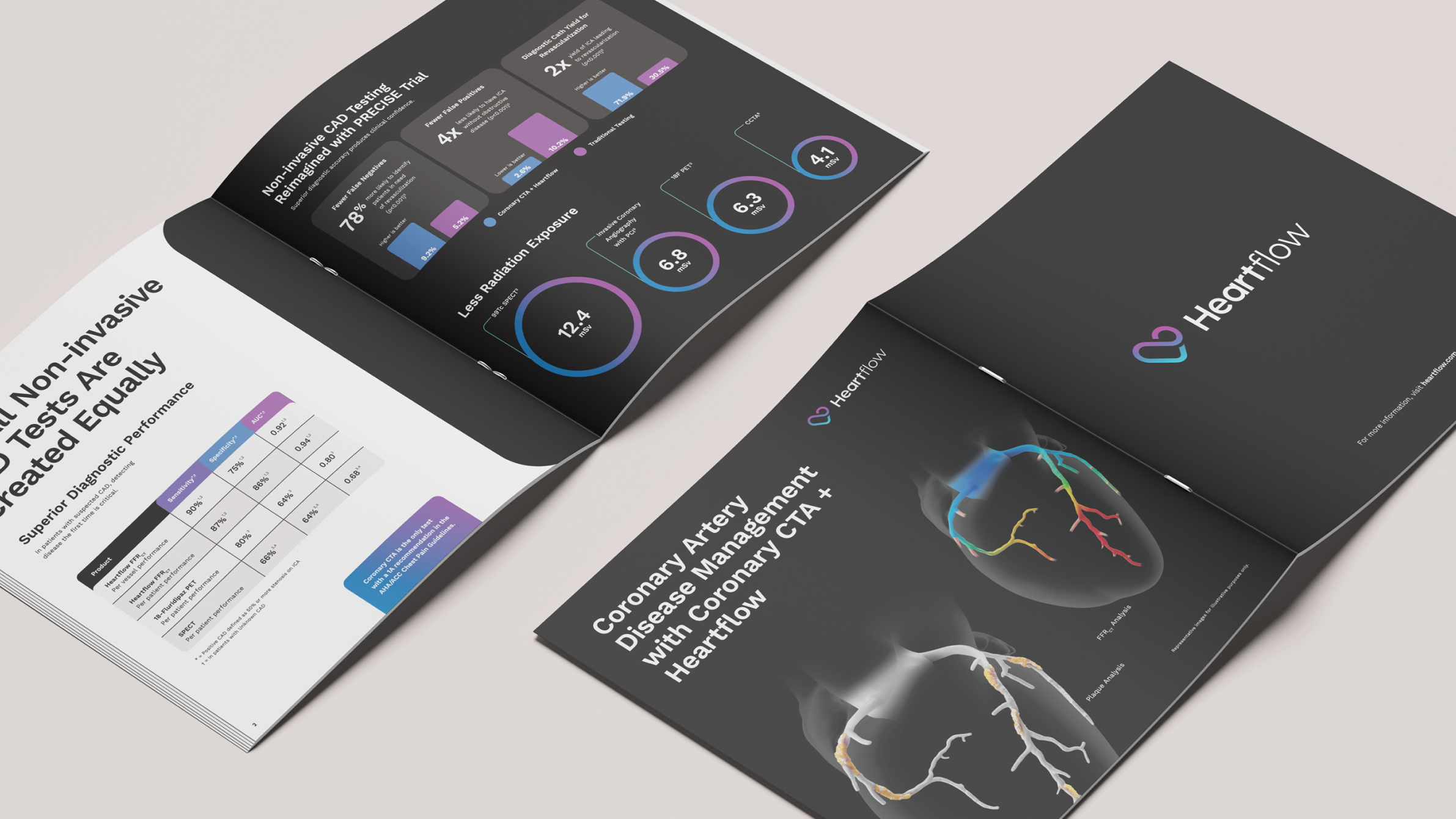
A single platform designed to unify everything Heartflow says and makes, from the corporate brand down to individual products.
Vision — Transform CAD from the leading cause of death to a disease that can be managed for life.
Mission — Heartflow is establishing a new era of personalized care by delivering AI-driven analysis and insights to manage CAD for life.
Brand Promise — Heartflow delivers the clarity and confidence that each clinical decision you make is the right one.
Brand Manifesto — The brand story anchors everything in stakes, not features: CAD has been the leading cause of death for over a century, often striking without warning. The point is it doesn't have to stay that way — a single CT scan, run through Heartflow's AI, becomes a window into a patient's future rather than just a diagnostic image. Closing on the line that became the strategic thesis for the whole platform:
"Today, CAD is no longer a silent threat. It's screenable, diagnosable, and manageable. With Heartflow, you don't just see CAD — you can manage it for life."
Validation
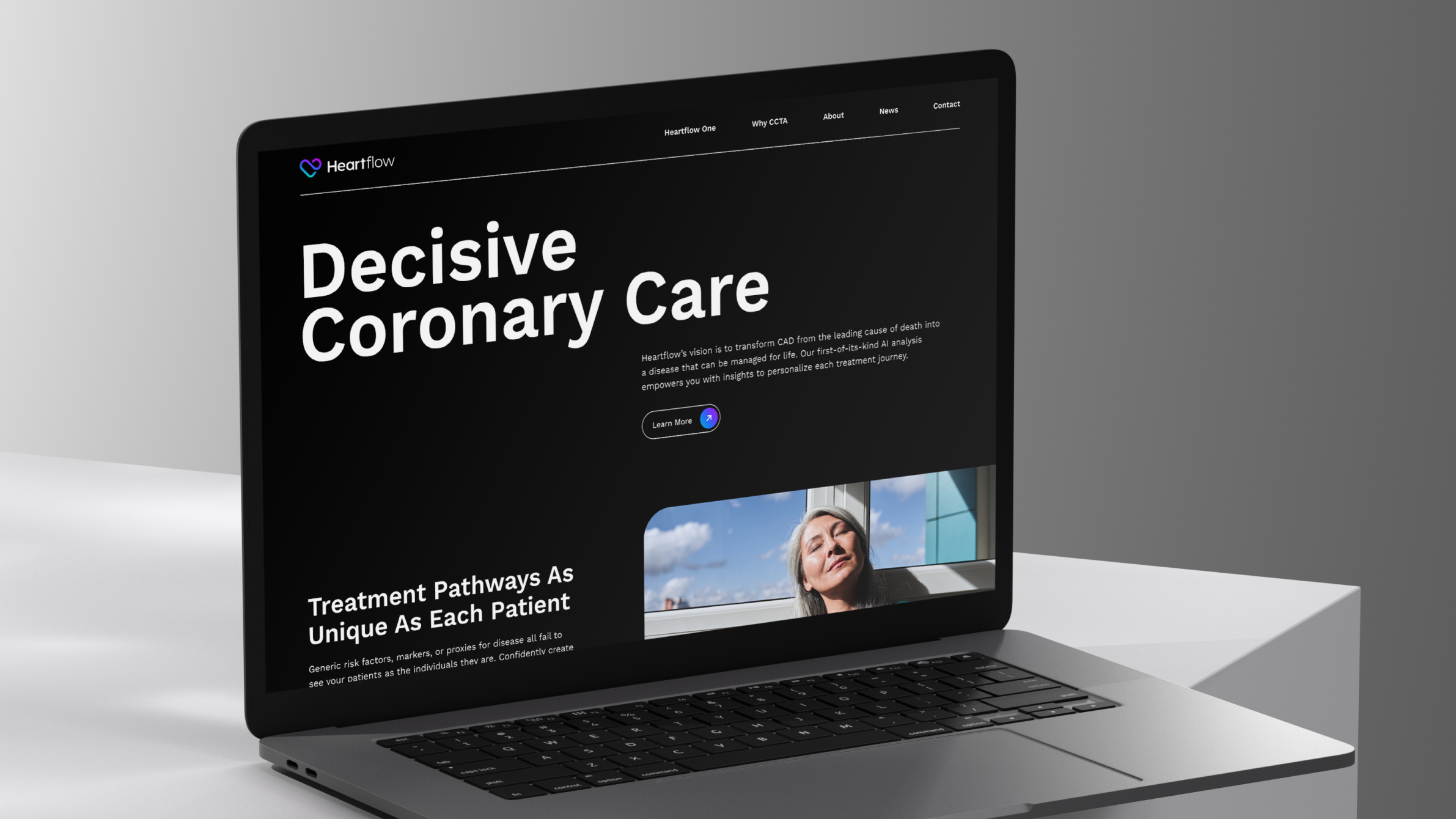
The platform wasn't just workshopped internally — it was pressure-tested against the exact audience it needed to convince. In 35 in-depth interviews, the concept built on this platform ("Decisive Coronary Care") outperformed the alternative, resonating with both current Heartflow users and clinicians less familiar with the brand.
What came back from research validated the strategic bets directly. On the manifesto: "It takes treatment a step further and makes it more personal... it makes the whole thing become more persuasive." On the positioning territory of partnership: "It's more than just some tool that we use — it's a partnership for life. That's a very powerful statement." On the platform's clinical credibility: "This concept gives the sense that Heartflow is pushing the boundaries of what current technology is capable of."
Outcomes
Heartflow moved from being understood as a single diagnostic tool to being positioned — and validated by the clinicians who'd use it — as the platform for managing CAD for life.
That platform carried Heartflow through its August 2025 public market debut — a $2.27B market-cap IPO that raised $364M — aligning executive, investor, product, and clinical storytelling into one coherent narrative at the moment it mattered most.
In the year that followed, the brand and content strategy behind that work helped drive a 41% year-over-year revenue increase, a 50% lift in qualified lead volume, and a 500%+ increase in content engagement. Competitive share of voice grew from 45% to 83%, and an integrated PR and communications strategy secured Tier 1 media coverage and drove 1,000%+ growth in unique visitor media reach.